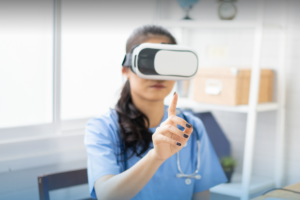
In the ever-evolving landscape of medical technology, augmented reality (AR) stands as a beacon of hope in the battle against Alzheimer’s disease. As we delve into the realm of AR, its potential in providing innovative solutions for cognitive stimulation and therapy becomes increasingly apparent. In this article, we explore the profound impact of augmented reality on Alzheimer’s treatment and the promising future it holds in transforming patient care.
Alzheimer’s disease, a progressive neurodegenerative disorder, poses significant challenges for both patients and caregivers. The hallmark symptoms of Alzheimer’s include memory loss, cognitive decline, and behavioral changes, all of which severely impact the quality of life. Traditional treatment approaches often focus on medication management and behavioral interventions. However, the advent of augmented reality has opened up new avenues for addressing the complex needs of Alzheimer’s patients.

Augmented reality cognitive stimulation programs offer a dynamic and interactive platform for engaging individuals with Alzheimer’s. Through immersive experiences and personalized activities, AR technology stimulates cognitive function and promotes neural plasticity. Patients can engage in virtual environments that mimic real-life scenarios, such as grocery shopping or navigating a city street, providing opportunities for memory recall and problem-solving.
One pioneering application of augmented reality in Alzheimer’s care is the development of specialized AR platforms tailored to the unique needs of patients. These platforms integrate cognitive exercises, memory games, and therapeutic interventions into immersive AR environments. By leveraging cutting-edge technology, healthcare providers can deliver targeted interventions that enhance cognitive abilities and slow the progression of the disease.
Augmented reality for Alzheimer’s not only offers cognitive stimulation but also serves as a powerful tool for cognitive therapy. AR-based interventions can target specific cognitive domains affected by Alzheimer’s, such as memory, attention, and executive function. Through interactive tasks and feedback mechanisms, patients receive personalized therapy that adapts to their individual needs and abilities.
The integration of augmented reality into Alzheimer’s therapy has shown promising results in clinical settings. Studies have demonstrated improvements in cognitive function, mood, and overall quality of life among patients participating in AR-based interventions. Furthermore, caregivers report a reduction in caregiver burden and improved patient engagement, highlighting the transformative potential of AR technology in Alzheimer’s care.

As we look to the future, the intersection of augmented reality and mental health holds immense promise for advancing Alzheimer’s treatment. Emerging technologies such as artificial intelligence and machine learning are poised to further enhance the capabilities of AR-based interventions. By harnessing the power of data analytics and predictive modeling, healthcare providers can deliver personalized care plans that optimize patient outcomes and improve treatment efficacy.
In conclusion, augmented reality represents a groundbreaking paradigm shift in the treatment of Alzheimer’s disease. From cognitive stimulation to therapeutic interventions, AR technology offers innovative solutions that address the complex needs of patients living with Alzheimer’s. As research continues to unfold and technology evolves, the vision of a future where augmented reality transforms Alzheimer’s care into a more effective, personalized, and compassionate endeavor draws ever closer.